
Immersion Cooling
LFP cells immersed in a dielectric fluid and cooled where the heat is produced. Available as an all-in-one C&I cabinet and as a utility-scale battery container.
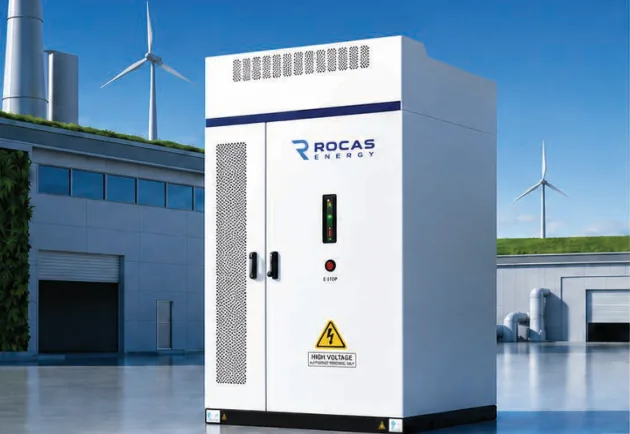
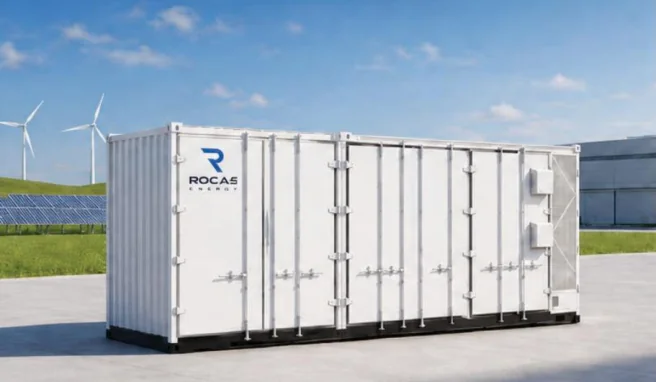
How immersion cooling works
Battery packs heat up as current flows through them, so every pack needs cooling. In a ROCAS immersion system the LFP cells sit in a dielectric fluid that does not conduct electricity. The fluid takes heat directly from the cell surface, helps limit thermal propagation between cells and keeps cell temperatures stable, which supports a longer cycle life.
The design uses two fluids. Besides the dielectric fluid, a water-glycol circuit handles extreme ambient temperatures. Two loop variants are available: the dielectric fluid circulates directly to the chiller and is cooled there, or it stays inside the pack and is cooled by the water-glycol circuit.
- Pumps, the heart
- Keep the coolant moving through every pack.
- Pipes, the arteries
- Carry the fluid to and from the battery packs.
- Dielectric fluid, the blood
- Surrounds the LFP cells and absorbs heat at the cell surface. The fluid is produced by Shell.
- Chiller, the lungs
- Removes the heat and returns the circuit to its target temperature.
What immersion changes
Direct heat pickup
The fluid touches the whole cell surface, so heat does not have to travel through plates and interfaces.
Even cell temperatures
Both ROCAS immersion datasheets list a cell temperature difference of 2 °C or less.
Layered safety
Immersion helps limit propagation between cells. It works together with the BMS, detection and fire suppression and does not remove fire risk on its own.
Datasheets
Technical datasheets in English for both immersion systems.
Discuss your project with ROCAS.
Power, capacity, site and timeline are enough to start. We reply with the right configuration and next steps.